_811205.png)
_e196d8.png)
_32b3d9.png)
_1c53fe.png)

Biological Realities of Car Crashes
It might not seem significant, but male and female anatomies are distinctly different. These biological variations warrant entirely different parameters for crash testing. Cars have become dramatically safer recently, but according to a new study from Graz University of Technology proves women are not benefiting equally. Researchers analyzed Austrian crash data from 2012 through 2024 to reconstruct real-world accidents. They found that female occupants face a 60% greater injury risk compared to men, even in lower-speed impacts.
Earlier data aligns with these findings, showing that women naturally carry a much higher risk of injuries and fatalities in a collision. Women are not simply smaller men. Differences in pelvic structure, chest shape, shoulder geometry, and spinal motion drastically affect how a human body absorbs kinetic energy.
Researchers noted that these unique physical traits make women significantly more likely to suffer serious trauma to their chests, spines, arms, and legs. Older women face the absolute greatest danger on the road.
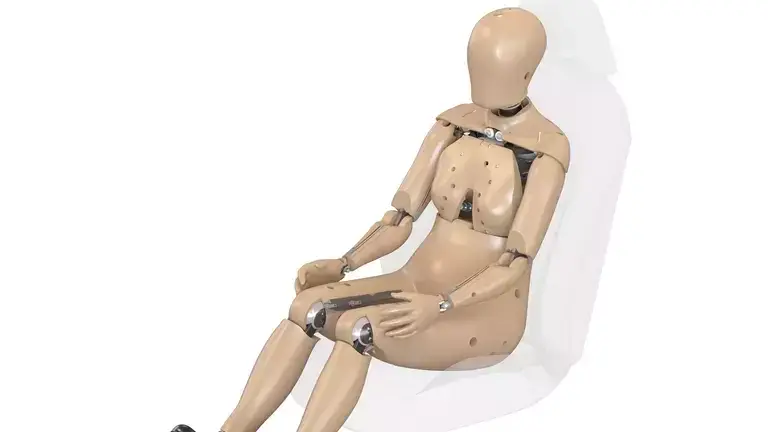
Humanetics
Fixing the Testing Gap
This safety gap exists because vehicle safety standards have spent decades catering to the average male body. The traditional female dummy was just a scaled-down male figure representing an extremely petite woman. We have reported how this oversight endangered lives for decades before regulators demanded change.
Studies confirm that 95% of actual women are physically larger than that outdated reference point. Women are also more likely to sit in the passenger seat and recline further back. This relaxed posture severely reduces the effectiveness of standard airbags and seatbelts.
Thankfully, the government and automakers are finally catching up. The US government recently introduced the THOR 05F crash test dummy. This advanced model relies on realistic female anatomy rather than a shrunken male silhouette. It uses sophisticated sensors to accurately measure the impact of collisions on female bodies.
Manufacturers are also responding with smarter restraint systems. The new Volvo EX60 features a multi-adaptive safety belt that monitors occupant size and posture in real time. The vehicle adjusts seatbelt loads instantly to protect passengers of all sizes.

Solving Complex Engineering Challenges
The automotive industry has an excellent track record of solving complex engineering challenges when forced to do so. It is unacceptable that it took until recently to acknowledge that half of the driving population requires tailored safety testing. Regulatory oversight needs to remain incredibly strict because even the smallest manufacturing details can jeopardize occupant safety. We see this constantly in production, where an issue as simple as an omitted informational label can trigger a sweeping vehicle safety recall.
True automotive safety must be comprehensive and forward-thinking. As new tech companies enter the automotive space, we are reminded that flawed physical engineering can have fatal consequences.
For example, recent high-profile accidents have exposed how flawed electronic door mechanisms can trap occupants inside a vehicle during emergencies. Regulators must ensure that as we fix the historical gender bias in crash testing, we do not let new hazards slip past standard validation procedures.
Join the conversation
You can post now and register later. If you have an account, sign in now to post with your account.