_811205.png)
_e196d8.png)
_32b3d9.png)
_1c53fe.png)

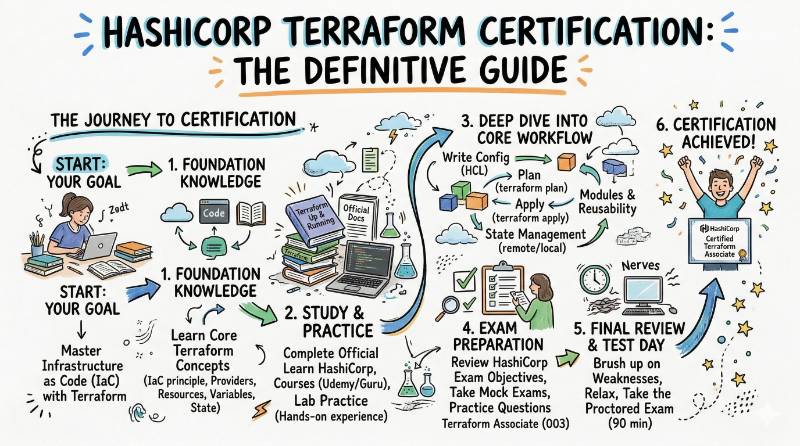
In the era of rapid cloud adoption, the role of a traditional systems administrator has evolved. We no longer “build” infrastructure; we “program” it. As someone who has spent two decades watching the industry shift from physical server racks to elastic cloud environments, I’ve seen many tools come and go. However, HashiCorp Terraform has solidified its place as the industry standard for Infrastructure as Code (IaC).
Whether you are a Software Engineer in Bangalore or a DevOps Manager in London, mastering Terraform is the key to managing complexity at scale. It transforms manual, error-prone tasks into repeatable, version-controlled code. This guide is designed to navigate you through the official certification path and show you how it integrates with other critical ecosystems like Kubernetes.
The HashiCorp Certification Landscape
The HashiCorp certification program is built to prove that an engineer can handle the lifecycle of cloud resources—not just “spin up a server,” but manage its state, security, and scalability over time.
Official Certification Matrix
| Track | Level | Who it’s for | Prerequisites | Key Skills | Recommended Order |
| Cloud Automation | Associate | DevOps, SRE, Cloud Engineers | Basic Cloud CLI Knowledge | HCL Syntax, State, Modules, Workflows | 1st |
Deep Dive: HashiCorp Certified: Terraform Associate
This credential is the global benchmark for infrastructure automation. It focuses on the open-source version of Terraform, ensuring your skills are portable across any cloud provider (AWS, Azure, or GCP).
What it is
The HashiCorp Certified: Terraform Associate is a professional-level validation of your ability to use the HashiCorp Configuration Language (HCL). It tests your proficiency in the core Terraform workflow—Init, Plan, and Apply—and your understanding of how Terraform maintains its “Source of Truth” through state files.
Who should take it
- Software Engineers: To gain “Full Cycle” ownership of their application environments.
- DevOps & SRE Professionals: For whom automation is the primary tool for reliability.
- Platform Engineers: Who build the internal cloud platforms that other developers use.
- IT Managers: Who need to understand the architectural constraints of automated environments.
Skills you’ll gain
Preparing for this exam forces you to adopt a “Code-First” mindset for operations.
- Declarative Programming: Describing the result you want, rather than the steps to get there.
- State Management Mastery: Learning how Terraform tracks thousands of resources and how to keep that data secure in a team environment.
- Modular Architecture: Building reusable “lego blocks” of infrastructure that can be shared across an organization.
- Provider Ecosystem: Understanding how to use a single tool to talk to hundreds of different services beyond just the cloud.
Real-world projects you should be able to do after it
- Multi-Cloud Disaster Recovery: Writing code that can rebuild your entire production environment in a different cloud region in minutes.
- Automated Security Compliance: Ensuring that every database created by your team is encrypted and behind a firewall by default.
- Self-Service Infrastructure: Creating a library of modules that allow developers to launch their own staging environments on demand.
- Drift Detection: Building pipelines that automatically alert you when someone makes a manual change in the cloud console.
Preparation Plan
- The 7-Day “Sprint”: Best for those already using Terraform daily. Focus on the nuances of Terraform Cloud and advanced state commands like
importandmv. - The 30-Day “Practitioner”: The recommended path. Spend two weeks building 3-5 distinct projects (VPCs, Load Balancers, Databases) and two weeks on mock exams and documentation.
- The 60-Day “Foundation”: For beginners. Spend the first month learning basic cloud services (AWS/Azure) manually before trying to automate them with code.
Common Mistakes
- Neglecting the State File: Many fail because they don’t understand how Terraform “remembers” what it built. Losing or corrupting a state file is a production disaster.
- Hardcoding Secrets: Putting passwords in your
.tffiles. Experts use variables and secret managers; beginners get hacked. - Skipping the ‘Plan’: Applying code without reviewing the plan first. This leads to the accidental deletion of production resources.
Beyond Infrastructure: The Next Step
Mastering Terraform is the first half of the battle. Once the infrastructure is built, you must master the applications running on it. I highly recommend the Certified Kubernetes Application Developer (CKAD) as your next milestone. Terraform builds the “ground” (the servers), and Kubernetes runs the “city” (the apps). Together, they are the two most powerful tools in modern tech.
Choose Your Path: 6 Specialized Career Tracks
Terraform is a gateway to several high-paying specialties:
- The DevOps Path: Focus on the speed of delivery. Build the “paved road” for software.
- The DevSecOps Path: Focus on security. Ensure every line of infrastructure code is scanned for vulnerabilities.
- The SRE Path: Focus on uptime. Use code to manage monitoring, logging, and automated recovery.
- The AIOps/MLOps Path: Focus on AI. Automate the massive GPU clusters needed for model training.
- The DataOps Path: Focus on data pipelines. Manage Snowflake or BigQuery environments as code.
- The FinOps Path: Focus on the cloud bill. Use automation to right-size resources and save the company money.
Role → Recommended Certifications
| Goal Role | Essential Certifications |
| DevOps Engineer | Terraform Associate, CKA, CKAD |
| SRE | Terraform Associate, CKAD, Google Professional Cloud DevOps |
| Platform Engineer | Terraform Associate, CKA, CKS (Security) |
| Cloud Engineer | Terraform Associate, AWS/Azure Associate |
| Data Engineer | Terraform Associate, Data Engineer Professional |
| FinOps Practitioner | Terraform Associate, FinOps Certified Practitioner |
| Engineering Manager | Terraform Associate, Cloud Practitioner, PMP |
Next Certifications to Take
Based on industry data from platforms like GurukulGalaxy, here are the three best directions to go after Terraform:
- Same Track (Automation): Certified Kubernetes Administrator (CKA).
- Cross-Track (Application): Certified Kubernetes Application Developer (CKAD).
- Leadership (Strategy): AWS or Azure Solutions Architect Professional.
Top Training Institutions for CKAD (CDE)
To transition from Terraform to Kubernetes, these institutions provide world-class training for the Certified Kubernetes Application Developer (CKAD):
- DevOpsSchool: A leader in hands-on training, focusing on project-based learning that prepares you for production challenges.
- Cotocus: Specializes in intensive bootcamps for working professionals who need to master container orchestration quickly.
- Scmgalaxy: A resource-rich community and training hub for those wanting to master the entire CI/CD toolchain.
- BestDevOps: Known for simplifying complex topics and helping engineers clear certifications on their first attempt.
- DevSecOpsSchool: Focuses specifically on securing Kubernetes environments and containerized applications.
- Sreschool: Dedicated to reliability training, ensuring your Kubernetes clusters are stable and observable.
- Aiopsschool: Bridges the gap between AI and DevOps, helping you run machine learning on Kubernetes.
- Dataopsschool: Focuses on the unique challenges of managing data and databases in a containerized world.
- Finopsschool: Teaches you how to optimize the costs of running massive Kubernetes clusters in the cloud.
FAQs: Certified Kubernetes Application Developer (CKAD)
1. Is CKAD harder than Terraform?
It is different. CKAD is 100% practical. You solve problems in a real terminal, so it tests your actual skills, not just memory.
2. How long should I study?
Usually, 4 to 8 weeks of consistent practice is sufficient for a working engineer.
3. Why take CKAD after Terraform?
Terraform sets up the playground; CKAD teaches you how to play the game. They are the two halves of a cloud career.
4. What is the exam format?
You get 15-20 tasks to complete in 2 hours on a live Kubernetes cluster.
5. Does it help with salary?
In India and globally, Kubernetes-certified professionals are among the highest-paid in the tech sector.
6. Can I use the documentation?
Yes, you are allowed one tab open to the official Kubernetes documentation during the test.
7. How long is it valid?
The certification is valid for 3 years.
8. Do I need to be a senior developer?
No, but you should be comfortable with the Linux command line and basic YAML files.
General FAQs
- How long is the Terraform exam? 60 minutes.
- Is it multiple choice? Yes, a mix of multiple-choice, multiple-response, and drag-and-drop.
- What is the passing score? Generally estimated around 70%.
- Can I take it from home? Yes, it is proctored online.
- How much does it cost? Approximately $70 USD.
- Does it expire? Yes, it is valid for 2 years.
- Is Terraform cloud-specific? No, it is cloud-agnostic, working with AWS, Azure, GCP, and more.
- Do I need a cloud account to practice? Yes, you should use a Free Tier account to build real resources.
- Why is Terraform so popular? Because it allows you to use one language for any cloud provider.
- What is HCL? HashiCorp Configuration Language, a human-readable language for defining infrastructure.
- Do I get a badge? Yes, a digital badge from Credly for your LinkedIn profile.
- Can I use notes during the exam? No, it is a closed-book exam.
Conclusion
Mastering HashiCorp Terraform is a defining moment for any cloud professional. It marks your transition from being a “user” of technology to an “architect” of automated systems. By earning this certification, you prove that you have the discipline to build stable, secure, and professional-grade infrastructure. However, the journey doesn’t end there. Combining Terraform with Kubernetes skills like the Certified Kubernetes Application Developer (CKAD) creates a powerful synergy that makes you essential to any modern engineering team. Start small, build your own projects, and never stop learning. The cloud is vast, but with the right tools, you can navigate it with total confidence.
Recommended Comments
Join the conversation
You can post now and register later. If you have an account, sign in now to post with your account.